
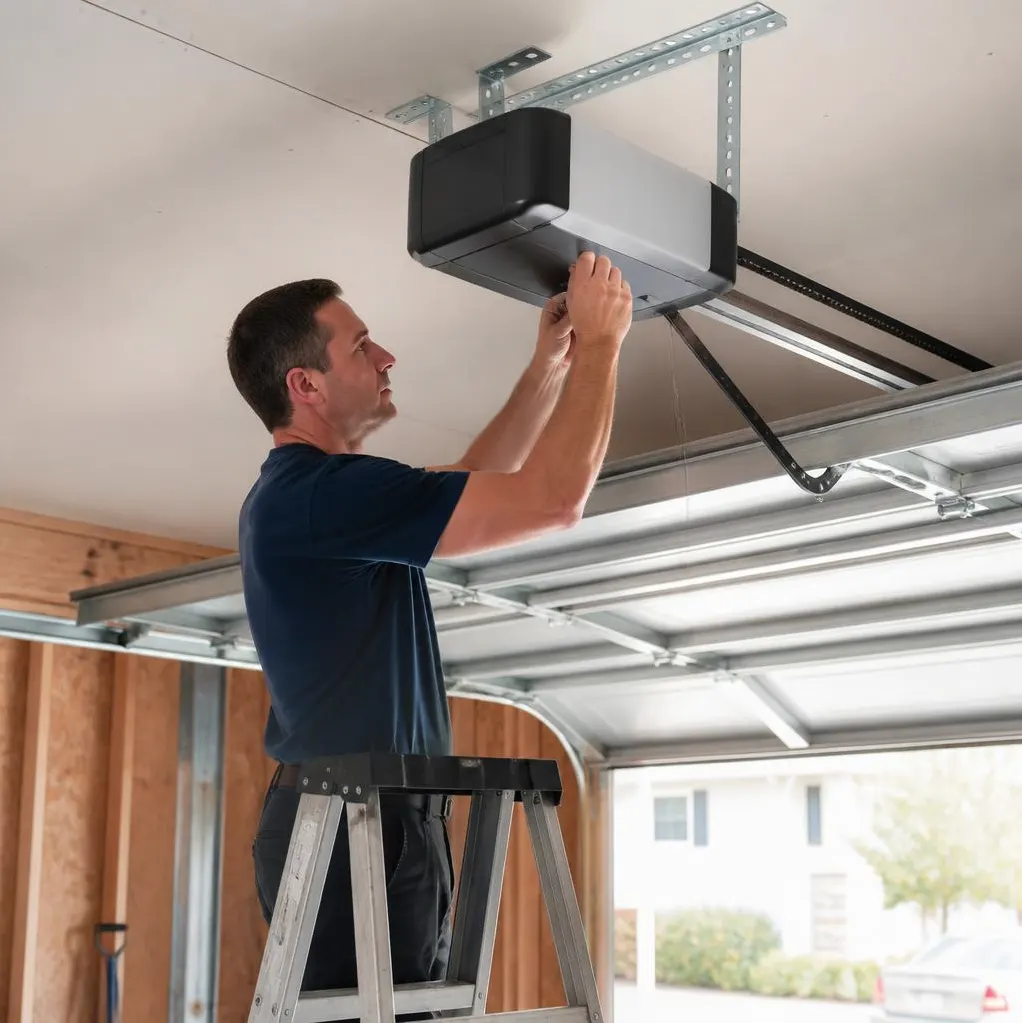
Short answer: it's almost always power, a safety sensor, or a spring
If your garage door won't open, the odds are good it's one of three things: the opener isn't getting power, a safety sensor is blocked or misaligned, or a spring has broken. Everything else — stripped gears, off-track cables, a stuck lock — happens too, just less often. A technician checks these in a specific order because it saves time and money: cheapest and most common first, most expensive and most mechanical last.
What the symptom tells you before anyone even opens the garage
How the door fails is the first clue. Pay attention to which of these matches your situation, because it narrows things down fast:
- Nothing happens at all — no motor sound, no lights. This points to power.
- The opener hums or clicks but the door doesn't move. This usually means the trolley is disconnected, a gear has stripped, or a spring has broken and the motor can't lift the weight.
- The door starts up, then reverses or stops partway. Classic safety sensor problem, or a track obstruction.
- The door opens a few inches and won't go further, or feels unusually heavy if you lift it by hand. That's a spring or cable issue, not the opener.
The order a technician actually checks things
1. Power to the opener
First check is always the simplest: is the opener plugged in, and is the outlet working? Garage outlets are frequently on a GFCI circuit, and GFCIs trip more often in damp conditions — which describes most of the year here. A tripped GFCI, a loose plug, or a breaker that's flipped will stop the opener cold with zero symptoms otherwise. This is a two-minute check and it's surprising how often it's the answer.
2. Safety sensors
Next, the photo-eye sensors mounted low on each side of the track. If they're misaligned, dirty, or something's blocking the beam, the opener refuses to close the door and may refuse to run at all depending on the model. Moisture, condensation on the lenses, and spiderwebs across the sensor eye are common here through the wet months, and a stray leaf or a garden hose left across the opening will do it too. The fix is usually just realigning and wiping down both sensors until their indicator lights go solid.
3. Manual lock or vacation switch
Some openers have a lock feature that disables the remote, usually triggered by accidentally holding the button too long or bumping a wall switch. It's an easy thing to rule out before assuming something's broken.
4. The emergency release cord
That red cord hanging from the trolley disconnects the door from the opener. If it's been pulled — sometimes by a tall item brushing against it, sometimes by kids — the opener will run but the door won't move with it. Reconnecting it is simple once you know to look.
5. Manual operation test
This is the step that really separates an opener problem from a door problem. With the trolley disconnected, a technician lifts the door by hand. If it's heavy, uneven, or won't move, the issue is mechanical — almost always a spring. If it lifts smoothly and evenly, the opener itself is the suspect.
6. Springs
A broken torsion spring is one of the most common reasons a door won't open, and it's usually obvious once you look: a visible gap in the coil, or a door that feels like dead weight when lifted. Springs are under serious tension and are not a do-it-yourself repair — this is a job for spring replacement with the correct spring size and winding for your door's weight. A single broken spring on a double door is especially common because the opener strains to compensate before finally failing.
7. Cables
If a cable has come off its drum or frayed, the door can bind on one side or drop suddenly. Technicians check cable tension and drum alignment right after the springs, since the two systems work together.
8. Tracks
Bent track, debris, or rust buildup can jam rollers in place. Rot and rust show up more here than in drier climates, especially on older steel tracks or wood-trim doors that have taken on moisture over multiple wet seasons. During cold snaps, a thin layer of ice on the track or in the roller housing can also stop a door cold until it's cleared.
8. Opener gears and motor
Last on the list because it's the least common cause and the most involved fix. Plastic drive gears inside the opener strip over time, especially on units ten-plus years old, and the motor itself can fail. A stripped gear usually sounds like grinding or a motor that runs without the chain or belt moving. This is a straightforward opener repair, though on an older unit it's sometimes more cost-effective to replace the opener than to keep patching it.
When to call Everett Garage Door
If you've ruled out power and the sensors and the door still won't budge — especially if it feels heavy or you spot a gap in a spring coil — stop trying to force it and call us. Forcing a door with a broken spring can damage the opener or the track, turning a single repair into several. We handle spring replacement and garage door opener repair regularly, and we'll walk the door through this same checklist on-site, explain exactly what failed, and give you a straight answer on repair versus replacement before any work starts.
If your garage door in Everett, Marysville, Lake Stevens, Mukilteo, Lynnwood, Mill Creek, Snohomish, or Edmonds won't open, give Everett Garage Door a call. We'll get it diagnosed and working again, no guesswork.